The Hoya carnosa, known as the Wax Plant or Porcelain Flower, is a structural masterpiece of the botanical world. Unlike standard tropicals that prioritize rapid, thin-leaved growth, this species is built for longevity and architectural beauty. In the world of indoor gardening, it is often treated as an heirloom, passed down through generations due to its ability to live for over half a century. However, the gap between a stagnant green vine and a plant overflowing with fragrant, porcelain-like flower clusters lies in understanding its complex biological triggers. Professional hoya carnosa care is a balance of environmental stress, precise nutrient cycling, and a deep respect for its epiphytic origins.
In this exhaustive authority guide, we break down the 12 technical pillars of Hoya success. We will move past basic watering tips and dive into the cellular mechanics, hormonal flows, and environmental engineering required to turn your Hoya into a blooming masterpiece.
The Epiphytic Foundation: Engineering the Aerial Root Zone
To master hoya carnosa care, you must first respect its status as a hemi-epiphyte. In its native subtropical habitats throughout East Asia and Australia, it does not grow in the compressed, anaerobic soil of the forest floor. Instead, it lives in the “V” of tree branches and rock crevices, feeding on decaying organic matter and breathing constant fresh air. Its roots are not subterranean anchors; they are aerial explorers. When we force these plants into heavy, peat-based potting soils, we are essentially suffocating the very system designed to keep them alive.
1. Indoor Environmental Adaptation and Resilience
The Hoya carnosa is a premier indoor plant specifically because it possesses a unique metabolic pathway known as Crassulacean Acid Metabolism (CAM). This is an evolutionary “shield” that allows the plant to close its stomata during the heat of the day to conserve moisture and open them at night to breathe and collect carbon dioxide. This specialized photosynthesis makes the Hoya incredibly resilient to the dry, stable air found in modern homes, where thinner-leaved tropicals like Calatheas would quickly suffer from leaf tip necrosis. Because it manages its gas exchange so efficiently, it is one of the most durable plants for a domestic setting, provided you do not treat it like a traditional ground-dwelling species.
2. Strategic Lighting and the Direct Sunlight Spectrum
A common point of confusion in hoya carnosa care is the plant’s relationship with the sun. While it is often marketed as a “shade-tolerant” plant, this is a dangerous half-truth that often prevents the plant from ever reaching its blooming potential.
Managing UV Exposure and Anthocyanin Stress
Hoya carnosa does not just like bright light; it requires it for flower induction. While direct midday summer sun can cause thermal leaf scorch visible as white, paper-like patches, soft direct morning or late afternoon sunlight is vital. This controlled exposure triggers the production of anthocyanins. These are protective pigments that turn the leaves a deep bronze or red. In the hobby, this is called sun-stressing, and it is a biological signal that the plant has stored enough excess energy to begin the reproductive cycle and push out flower clusters.
3. Hydration Mechanics and the Taco Test for Turgor
Because of its succulent-like leaves, the Hoya carnosa manages water internally rather than relying on constant external soil moisture. Overwatering is the single most common cause of death for this species, as it leads to a total vascular collapse that is often invisible until it is too late.
The Taco Test for Internal Hydration
To scientifically assess hydration, professional growers perform the taco test. Gently attempt to fold a mature leaf between your fingers. High turgor pressure in a hydrated plant will make the leaf feel rigid and impossible to bend. If the leaf is flexible, rubbery, or folds easily, the plant has depleted its internal water reservoirs. This is your cue to provide a deep drench, ensuring the water saturates the entire root ball.
4. Soil Porosity and Cation Exchange Engineering
Since Hoyas are epiphytes, they require a soil medium with a high Cation Exchange Capacity (CEC) and maximum aeration. A professional-grade mix consists of one part potting soil, one part perlite, and one part orchid bark. This chunky texture ensures that oxygen is always available to the root hairs, even immediately after watering. Without this porosity, fungal pathogens such as Phytophthora will rot the roots within days. The goal is to create a substrate that mimics the tree bark and leaf litter of its natural home.
5. Growth Economics and Market Value Factors
You may wonder why Hoya carnosa is so expensive compared to a faster-growing Pothos or Philodendron. The reason is purely biological growth economics. Hoyas have a much slower metabolic rate and a significantly longer juvenile phase. It takes a professional nursery several years of precise maintenance to grow a specimen to a size where it is ready to bloom. Rare variegated versions, such as the Krimson Queen or the Compacta (Hindu Rope), grow even slower because they possess less chlorophyll for energy production. Their market price is a direct reflection of the time, labor, and greenhouse space required to produce them.
6. Peduncle Physics: The Permanent Bloom Site
This is the most critical technical rule of hoya carnosa care: Never prune the flower stalks. These small, woody nubs are called peduncles. Unlike most flowering plants that grow new flowers on new green wood, the Hoya carnosa re-blooms from the exact same peduncle year after year. Every time a peduncle produces a cluster of flowers, it grows slightly longer and sturdier. Pruning these stalks effectively sterilizes that section of the vine for future flowering, forcing the plant to spend valuable energy growing an entirely new peduncle from scratch.
7. Vertical Auxin Flow: The Advantage of Climbing
While Hoyas are visually stunning in hanging baskets, they are biologically programmed to be climbers. When a Hoya vine is allowed to climb a trellis, bamboo hoop, or moss pole, the flow of auxins (growth hormones) changes within the stem. Climbing upward signals to the plant that it is ascending the forest canopy and reaching for the sun. This hormonal shift triggers the production of significantly larger leaves and more frequent peduncles compared to vines that are left to hang and trail downward.
8. Atmospheric Humidity and Transpiration Management
While CAM photosynthesis helps the plant survive in dry indoor air, high humidity—ideally above 50%—is essential for the development of new growth points. Low humidity causes a phenomenon known as stuck leaves, where the new foliage cannot break free from the protective sheath at the tip of the vine. This leads to deformed, scarred, or stunted growth. A stable, humid micro-climate ensures the waxy leaf cuticle remains glossy and that the aerial roots can absorb trace amounts of moisture from the air.
9. Thermal Stability and Bud Blast Prevention
The Hoya carnosa is a subtropical species that thrives in temperatures between 65°F and 85°F. While it can handle slightly cooler nights, it cannot handle frost or sustained temperatures below 50°F. Keeping the plant away from sudden cold drafts or air conditioning vents is essential, especially when it is in the budding phase. A sudden temperature shock can cause bud blast, where the plant aborts its flower clusters to protect its core energy reserves.
10. Nutrient Cycling and Phosphorus Loading
To support the energy-intensive process of flowering, a Hoya needs more than just nitrogen for leaf growth. During the active growing season in late spring and summer, you should provide a balanced liquid fertilizer. However, every third watering, consider switching to a fertilizer with a higher phosphorus count (the middle number). This phosphorus loading provides the chemical energy required for the plant to push out its dense, nectar-heavy porcelain flowers and maintain the health of the permanent peduncles.
11. Root Constriction and Reproductive Stress Triggers
Hoyas are among the few plants that actually prefer to be slightly root-bound. In a massive pot with too much soil, the plant focuses all its energy on vegetative expansion, growing roots to fill the space. In a snug, constricted pot, the plant feels a slight biological stress that triggers its reproductive phase. This results in much more frequent flowering. You should only repot a Hoya carnosa every 3 to 5 years, and only when the roots have completely occupied the container.
12. Water Propagation and the Root Transition Limitation
While you can easily propagate Hoya cuttings in water, growing them in just water permanently is not a long-term solution for a healthy plant. Water-grown roots are biologically different from soil roots; they are thinner and lack the protective corking needed to survive in a more abrasive potting medium. Furthermore, Hoyas are epiphytic and require a high level of oxygen at the root zone that a static liquid medium cannot provide indefinitely. For a healthy, long-lived plant, it is best to transition water-rooted cuttings into a chunky aroid mix as soon as the roots reach two inches in length.
Advanced Hoya Carnosa Varieties for Collectors
To truly master the niche, you should be familiar with the different cultivars of Hoya carnosa, each requiring slightly different nuances in care:
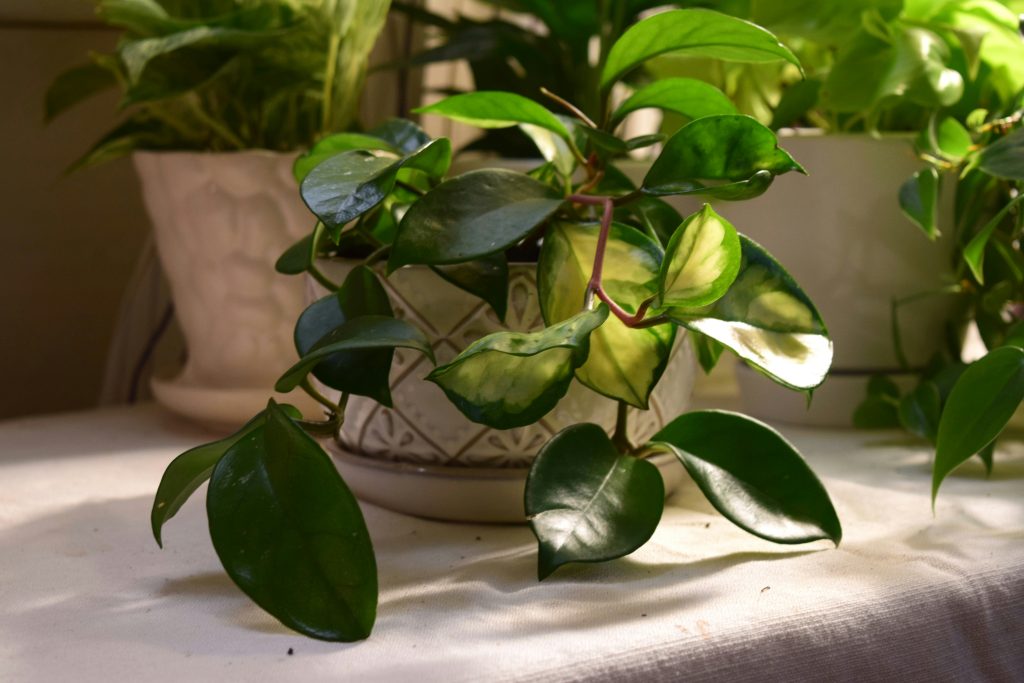
- Hoya Carnosa ‘Krimson Queen’: This variety features white or pink variegation on the outer edges of the leaves. It requires slightly more light than the standard green version to maintain its bright colors.
- Hoya Carnosa ‘Krimson Princess’: Unlike the Queen, the Princess has variegation in the center of the leaf. It is a slightly faster grower but is more sensitive to overwatering.
- Hoya Carnosa ‘Compacta’ (Hindu Rope): Known for its tightly curled, waxy leaves. This variety is a magnet for mealybugs, so frequent inspections inside the leaf curls are mandatory.
- Hoya Carnosa ‘Jade’: The classic solid green version, known for being the hardiest and most prolific bloomer of the group.
Seasonal Care Calendar for Peak Performance
Spring (March – May): The Awakening
This is the time to increase watering and begin your fertilization schedule. As light levels increase, move your Hoya closer to the window to trigger the development of new peduncles. This is also the ideal time for pruning and propagation.
Summer (June – August): The Blooming Phase
Keep the plant stable. Avoid moving it if it has developed buds. Ensure humidity is high and monitor for pests like aphids that are attracted to the sweet nectar produced by the flowers.
Fall (September – November): The Slowdown
As the days shorten, reduce the frequency of fertilization. Allow the soil to dry out a bit more between waterings as the plant’s metabolic rate begins to decrease in response to the changing light.
Winter (December – February): The Dormancy
This is the rest period. Stop all fertilizer and water only when the leaves show slight signs of wrinkling. Keep the plant in a cooler room (around 60°F) if possible, as this cool-down period often helps trigger a massive bloom cycle the following spring.
Troubleshooting: Professional Solutions to Common Issues
- Wrinkled and Leathery Foliage: If the soil is wet but the leaves are wrinkled, you have root rot. The roots have died and can no longer transport water to the leaves. You must take healthy cuttings immediately to save the genetics of the plant and discard the rotten root system.
- Sap Oozing from Stems: This is normal. Hoyas produce a milky white latex sap when cut. However, if the sap is clear and sticky on the leaves without any flowers present, check for scale insects or aphids.
- No Flowers After 5 Years: The plant is likely not receiving enough light or the pot is too large. Increase light intensity and avoid repotting to encourage reproductive stress.
- Black Spots on Leaves: This is often a sign of fungal leaf spot caused by water sitting on the foliage in a room with poor airflow. Increase circulation and avoid misting the leaves directly.
Conclusion: Achieving Hoya Excellence
Mastering hoya carnosa care is a rewarding exercise in botanical patience. This is not a plant for those seeking instant gratification; it is a companion that grows and evolves with you over the decades. By providing a high-porosity soil mix, high-intensity indirect light, and maintaining a snug root system, you can transform a simple green vine into a fragrant, blooming heirloom. The reward of those first porcelain-like flowers, with their heavy nocturnal scent, is the ultimate achievement for any serious indoor gardener.
FAQs
1. Is Hoya carnosa an indoor plant?
Yes, it is one of the most durable indoor plants available due to its CAM metabolism and thick, waxy leaves that handle indoor air exceptionally well.
2. Why is Hoya carnosa so expensive?
Their high price tag is a result of their slow growth rate and the several years of expert care required to produce a mature, flowering specimen.
3. Does Hoya carnosa like direct sunlight?
It thrives in very bright light. While it needs protection from the harshest midday summer sun, it benefits greatly from soft, direct morning or late afternoon sunlight.
4. How do you care for a Hoya carnosa?
The key is a chunky, high-porosity soil mix, allowing the plant to dry out significantly between waterings, and providing high-intensity indirect light.
5. Do Hoyas prefer to hang or climb?
While they can trail, they are natural climbers. Providing a trellis or hoop triggers growth hormones that lead to larger leaves and more frequent blooms.
6. Can you grow a Hoya in just water?
You can propagate them in water easily, but for long-term health, they require a soil medium that allows for the oxygen exchange their epiphytic roots need.
7. How long does it take for a Hoya to bloom?
It typically takes between 2 and 7 years for a Hoya to reach maturity and start its flowering cycle, depending on light and pot size.
8. Why are the leaves on my Hoya turning yellow?
This is almost always a sign of overwatering or poor soil drainage. Ensure you are using a chunky mix and letting it dry out.
9. Do Hoya flowers smell?
Yes, they produce a very sweet, heavy fragrance similar to chocolate or vanilla, which is strongest during the night.
10. What is a peduncle?
It is the permanent, woody flower stalk. You must never cut these off, as the plant will bloom from the same stalk every year.