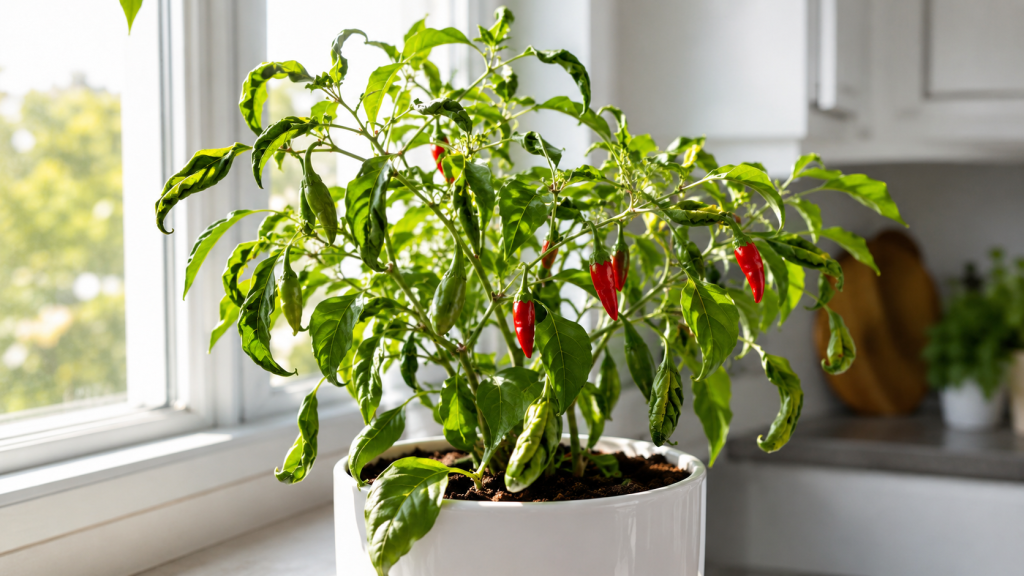
Growing hot chilies or sweet peppers right inside your home brings a vibrant, fiery touch to your indoor edible collection. Chili plants are visually stunning, but they are also highly expressive. When something goes wrong in their microclimate, they won’t hesitate to show it. One of the most alarming sights for any indoor kitchen gardener is looking at their windowsill pot and noticing the once-flat, deep green foliage twisting, distorting, or curling up like little cups.
If you are currently facing this issue and wondering why are my indoor chili plant leaves curling, it is important to treat this as an early warning distress signal. Leaf curling isn’t a disease itself; it is a physical defense mechanism. The plant is either trying to reduce its surface area to stop moisture loss, or its cellular tissue is being physically damaged from underneath.
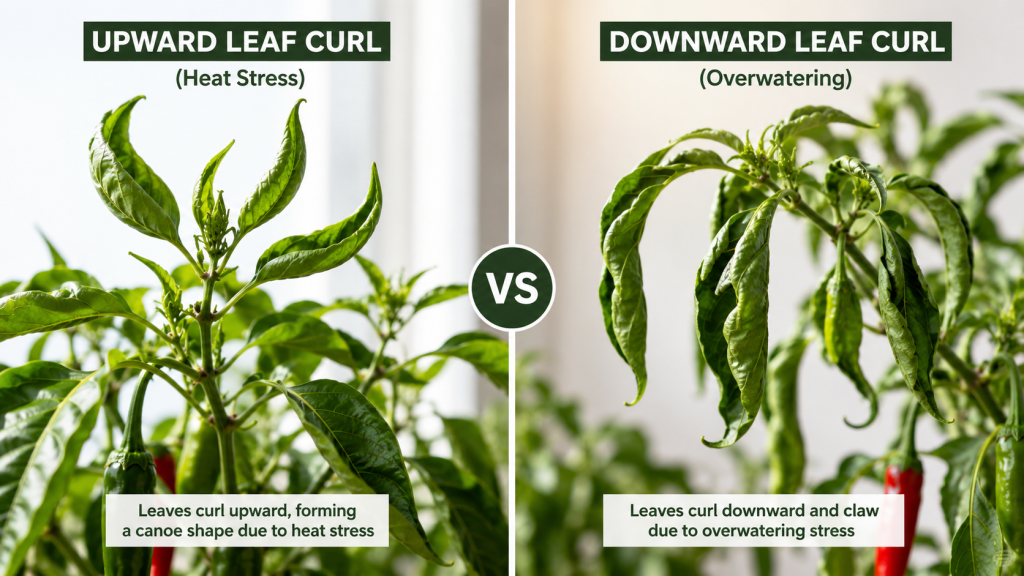
To successfully diagnose your plant, you must look closely at the direction of the curl. Are the leaves cupping upward toward the light, or are they clawing downward into the soil? Here is the ultimate, text-based diagnostic blueprint to identify the exact cause and the 5 best structural fixes to restore your indoor chili plant.
Upward vs. Downward: Read the Direction of the Curl
Before applying any treatments, inspect your plant’s leaves closely. The direction of the curling tells you almost everything you need to know about the root problem.
Upward Curling (Cupping)
When chili leaves curl upward at the edges, forming a canoe or cup shape, it is typically an environmental defense mechanism. The plant is experiencing excessive heat, light stress, or severe dry air. By rolling its leaves upward, it is desperately trying to shade itself and protect its microscopic breathing pores (stomata) from evaporating too much water.
Downward Curling (Clawing)
When the leaves roll downward, looking like an inverted cup or a bird’s claw, it points toward internal or physiological stress. This is usually triggered by overwatering, root suffocation, severe sucking pest infestations on the undersides of the leaves, or heavy nutrient toxicities.
1. Eliminate Sap-Sucking Pests (The Under-Leaf Attack)
By far, the most destructive cause of downward leaf curling in indoor chili plants is an attack by microscopic sap-sucking pests. Because indoor spaces lack natural predatory insects like ladybugs, pest populations can explode unchecked within days.
The Culprits
- Broad Mites & Spider Mites: These are practically invisible to the naked eye. They congregate on the tender, new growth at the top of the plant, sucking nutrients straight out of the plant cells. This uneven cellular damage causes the new leaves to grow out highly distorted, stunted, and severely curled downward.
- Aphids & Thrips: These larger insects cluster on the soft undersides of leaves and stems, leaving behind a sticky residue called honey dew.
The Best Fix
- Inspect with Magnification: Use a magnifying glass or your smartphone’s zoom camera to check the undersides of the curled leaves and the junction of new stems.
- The Organic Spray Regimen: Wash down the foliage thoroughly in the sink to physically dislodge the pests. Then, spray the entire plant—especially the undersides of every leaf—with an organic insecticidal soap or a diluted neem oil solution. Repeat this spray once every 5 to 7 days for three consecutive weeks to break the pest breeding cycle.
2. Correct Waterlog and Soil Suffocation
Chili plants are notorious for wanting hot feet and dry knees. While they require consistent moisture to fuel pepper production, their root systems are incredibly sensitive to standing water. If your indoor potting mix stays continuously muddy or saturated, the roots lose access to oxygen, leading to root rot.
The Warning Signs
- The leaves curl downward, look bloated, feel soft or leathery, and the lower foliage begins turning yellow.
- The soil smells stagnant, or a white mold film forms on the surface.
The Best Fix
- The Cycle of Wet and Dry: Switch your watering approach immediately. Never water chili plants on a set weekly schedule. Push your finger 1 to 2 inches deep into the soil; if it feels even slightly damp, leave it alone. Wait until the top layer of soil dries out fully before watering again.
- Drainage Upgrade: Ensure your pot has structural drainage holes at the bottom. If water pools in the decorative saucer beneath the pot, empty it within 10 minutes of watering so the roots never sit in a stagnant pool.
3. Mitigate Light and Heat Stress (The Windowsill Burn)
Chilies love light, but there is a distinct limit to what their leaves can handle indoors—especially if they are sitting directly up against a glass window pane or too close to an unventilated artificial LED grow light.
The Warning Signs
- The leaves curl upward, trying to shield their surfaces.
- The edges of the leaves look dry, crisp, or develop pale bleached patches (sunscald) from intense localized heat.
The Best Fix
- Adjust Grow Light Distance: If you are using high-output LED grow lights, ensure they are positioned at least 12 to 18 inches away from the top canopy of the chili plant. If the light is too close, the intense radiation triggers rapid leaf curling even if the room temperature feels fine.
- Manage Window Radiation: During intense summer afternoons, glass windows can act like a magnifying glass, trapping heat. Move the pot back a few inches from the hot glass pane to allow air to circulate around the container.
4. Fix Calcium Deficiency and Nutrient Imbalances
Indoor container plants rely 100% on you for their nutrition. If you notice the brand-new leaves emerging from the top of the chili plant looking crinkled, severely curled, and hooked at the tips, your plant is struggling with a calcium deficiency.
The Science Behind It
Calcium is a crucial building block used to create strong plant cell walls. Unlike other nutrients, calcium cannot move freely within the plant; it relies entirely on the plant’s water transpiration stream to travel from the roots up to the newest leaves. If indoor humidity is completely stagnant, or if the soil is kept too wet, the plant cannot transpire properly, causing a localized calcium shortage at the growth tips.
The Best Fix
- Apply Cal-Mag: Feed your plant a specialized water-soluble calcium-magnesium (Cal-Mag) supplement during your next watering session.
- Avoid Nitrogen Excess: Ensure you are not overfeeding your chili with high-nitrogen fertilizers. Too much nitrogen causes rapid, explosive leaf growth that outpaces the root system’s ability to supply calcium, resulting in heavily curled and misshapen leaves.
5. Increase Ambient Indoor Air Circulation
Stagnant air is the silent enemy of indoor edible crops. In an outdoor environment, natural wind constantly moves the leaves, pushing away excess moisture and encouraging strong, thick stem development. Indoors, stagnant air stalls the plant’s natural cellular processes.
The Best Fix
- Instate an Oscillating Fan: Set up a small, low-voltage household fan near your indoor garden. Keep it running on a low setting, directing a gentle breeze across the plants.
- The Benefits: This movement prevents moisture from pooling under the leaves, lowers pest populations (pests hate wind), and naturally helps the plant transpire water efficiently, which directly prevents leaf curling issues.
Conclusion
Fixing an indoor chili plant leaves curling up or down comes down to identifying the specific environmental trigger. By mapping out the direction of the curl—treating upward cupping as a plea for heat relief and downward clawing as a sign of pest or moisture stress—you can execute the perfect fix. Clean the undersides of the leaves with neem oil, let the soil dry out fully between waterings, and keep the indoor air moving with a simple fan. Once these parameters are balanced, your chili plant will gladly flatten its leaves out, focusing its full energy on producing a heavy harvest of fresh peppers.
Frequently Asked Questions
1. Can a chili plant recover from leaf curl virus indoors?
If the leaf curl is caused by an actual viral pathogen (usually transmitted by whiteflies outdoors), there is no cure, and the plant must be discarded. However, indoors, 95% of chili leaf curling is strictly environmental or pest-related (mites/aphids). Once you eliminate the pests or fix your watering habits, the plant will produce completely normal, healthy leaves again.
2. Why do my indoor chili leaves curl after I apply fertilizer?
This is a symptom of fertilizer burn or nutrient toxicity. When too much chemical fertilizer is added to a small indoor pot, the excess salts accumulate in the soil and pull moisture away from the roots, causing the leaves to curl downward and develop dark, crispy tips. Always dilute synthetic fertilizers to half-strength for indoor pots.
3. Should I prune away the heavily curled leaves from my pepper plant?
If the leaves are just curled but still green, leave them on the plant. They are still actively performing photosynthesis and generating energy. However, if the leaves have turned completely yellow, brown, or are heavily covered in pest webbing, snip them off with clean scissors to help the plant focus on new growth.
4. How can I distinguish between broad mite damage and watering issues?
Broad mite damage occurs strictly on the youngest, most recent growth at the very top of the plant, causing the tiny emerging leaves to look severely twisted, narrow, and clawed. Overwatering or root stress usually affects the entire plant or the older, lower leaves first, accompanied by yellowing foliage.
5. Does low indoor humidity cause chili leaves to curl?
Yes. If your indoor heating or cooling system drops the room humidity below 40%, the dry air draws moisture out of the pepper leaves faster than the roots can replenish it. The plant will curl its leaves upward at the edges to minimize its exposure to the dry air currents.