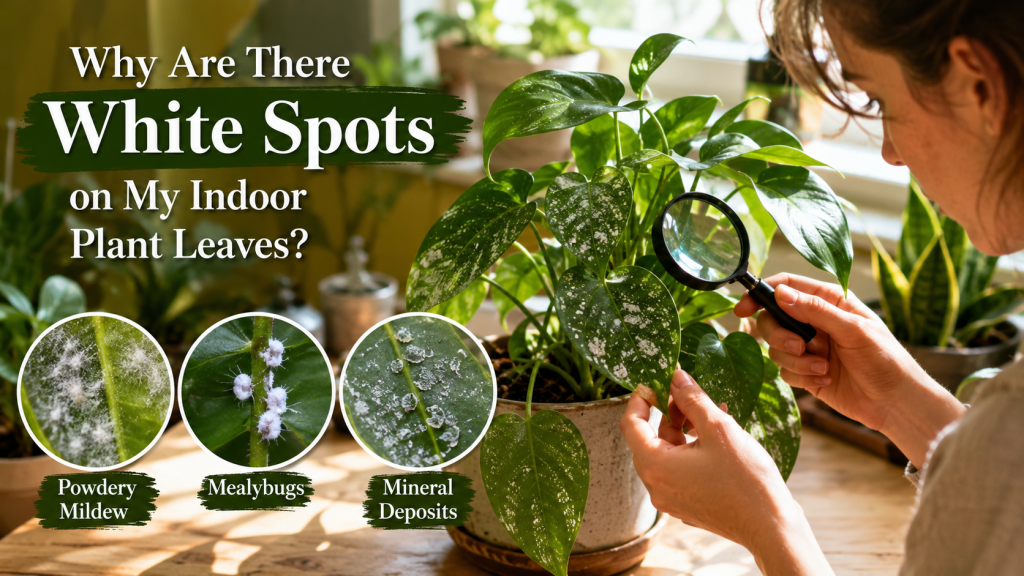
Why are there white spots on my indoor plant leaves? This is a question that catches many plant parents by surprise when they notice unsightly blemishes, powdery coatings, or tiny fuzzy specks ruining their houseplant’s beautiful foliage.
Unlike a leaf that turns completely yellow or brown due to general stress, white spots point to very specific issues, ranging from infectious fungal diseases and active pest invasions to harmless mineral deposits left behind by your tap water.
When you spot white marks on your indoor garden, ignoring them can lead to a rapid decline in your plant’s health. Fungal spores can spread to nearby pots, while sap-sucking insects can quickly multiply and drain the life out of your green collection.
To stop the damage and restore your foliage, you need to identify the exact cause behind these marks and apply the right treatment. Here is a comprehensive troubleshooting guide to understanding why your houseplant has white spots and how to get rid of them safely.
The Big Three: Classifying the Type of White Spots
Before treating your plant, you must look closely at the texture and behavior of the white marks. In indoor gardening, white leaf spots almost always fall into one of these three categories:
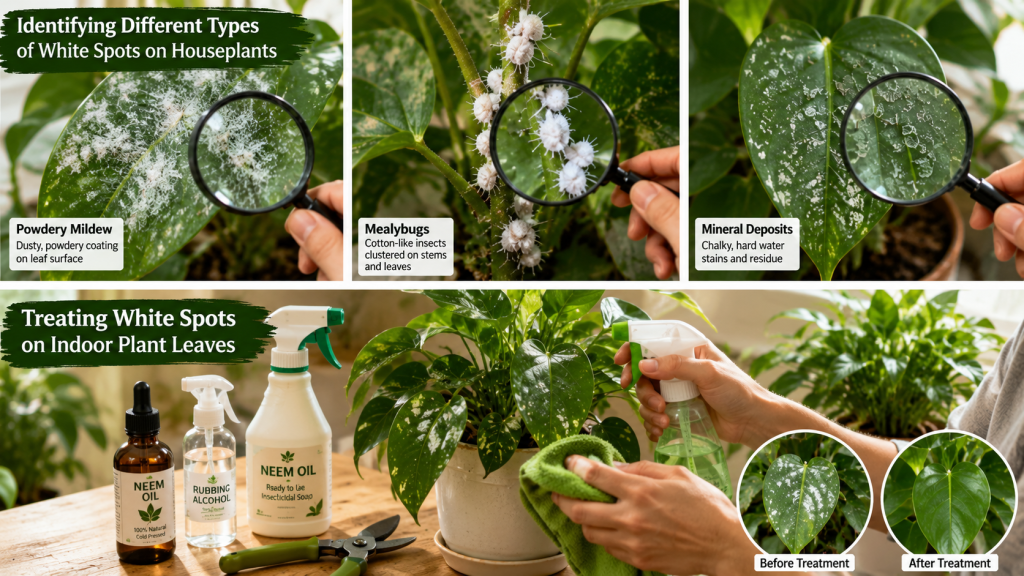
- Fungal Coating: A dusty, flour-like substance that sits on top of the leaf and can be wiped away easily with your finger.
- Pest Infestations: Tiny, sticky, cotton-like masses or moving flecks clustered under leaves or around the stem nodes.
- Structural Marks: Hard, crusty rings or pale, bleached patches that are embedded into the actual cellular tissue of the leaf.
1. Powdery Mildew (The Fungal Epidemic)
The single most common culprit behind dusty white marks on houseplants is powdery mildew. This is a fungal disease caused by various microscopic airborne spores that thrive in warm, stagnant indoor air.
It starts as discrete, small, circular white spots on the upper surface of older leaves. If left unchecked, these circles expand and merge together, creating a thick, white, velvety blanket of fungus that blocks sunlight, halts photosynthesis, and eventually causes the leaves to distort and drop.
The Warning Signs
- The spots look exactly like a light dusting of baking flour or baby powder on top of the foliage.
- You can easily brush or wipe the white dust off the leaf surface, but it returns a few days later.
- It spreads rapidly to sensitive plant species like African violets, begonias, ivy, and jade plants.
How to Fix It
- Isolate the Plant: Instantly move the infected houseplant away from your other greens to prevent the fungal spores from drifting across your room.
- Pruned-Sized Leaves: Cut away heavily coated leaves using sanitized pruning shears to reduce the overall fungal load on the plant.
- Apply an Antifungal Spray: Mix one tablespoon of baking soda and half a teaspoon of liquid dish soap into one gallon of water. Spray this thoroughly over all leaf surfaces, or use an organic copper fungicide to kill the remaining spores.
2. Mealybug Invasions (The Fuzzy Sap Suckers)
If the white spots on your plant look less like dust and more like tiny clumps of cotton wool, you are dealing with a mealybug infestation. Mealybugs are soft-bodied, slow-moving insects that cover themselves in a white, waxy, powdery substance to protect their bodies from drying out and to shield themselves from predators.
They hide in the tight crevices where the leaf stems meet the main stalk, piercing the plant tissue to suck out vital juices, which causes stunted growth and leaf yellowing.
The Warning Signs
- The white spots are sticky to the touch and form cottony clusters in hidden nooks, leaf axils, and under the foliage.
- The plant leaves feel sticky due to “honeydew”—a sugary waste substance excreted by the feeding insects.
- You notice small, clear ants crawling on your pots, attracted by the sticky honeydew.
How to Fix It
- Dab with Rubbing Alcohol: Dip a cotton swab or Q-tip into 70% isopropyl rubbing alcohol and press it directly onto the white fuzzy spots to dissolve the insect’s protective wax and kill them instantly.
- Wash the Foliage: Take the plant to the sink or shower and blast the leaves with a firm stream of lukewarm water to physically sneak loose the juvenile pests.
- Use Neem Oil Treatment: Spray the entire plant weekly with an organic neem oil solution to disrupt the life cycle of any remaining mealybugs.
3. Hard Water Deposits and Edema (Mineral Crusts)
Sometimes, white spots aren’t alive at all. If you water your houseplants with heavy tap water, the water contains high amounts of dissolved minerals like calcium, lime, and magnesium.
When you mist your plants, or when water splashes onto the foliage during a chore, the water evaporates into the room air, leaving behind hard, white, chalky mineral rings on the leaf surfaces. Similarly, plants can excrete excess salt minerals through their natural leaf pores (hydathodes), leaving behind tiny white crystals along the edges.
The Warning Signs
- The white spots form perfect circular rings or crusty white dots specifically along the outer margins or underside of the leaves.
- The spots feel gritty, rough, or chalky when you rub them, and they do not spread or move.
- The plant looks completely vibrant, healthy, and continues to put out new green growth.
How to Fix It
- Wipe with Vinegar: Mix a few drops of white vinegar or lemon juice into warm distilled water. Dampen a soft microfiber cloth with the mixture and gently wipe down the leaves to dissolve the alkaline mineral crust.
- Switch to Pure Water: Stop using heavy tap water. Water your sensitive houseplants with distilled water, collected rainwater, or filtered reverse-osmosis water instead.
- Clean the Potting Mix: Flush the soil mix thoroughly with pure water once every few months to wash away built-up salts from the container.
4. Spider Mite Damage (Tiny Pale Flecks)
Spider mites are microscopic arachnids that are almost impossible to see individually with the naked eye. Instead of seeing the actual pest, you see the collective damage they leave behind, known as stippling.
As thousands of spider mites pierce individual leaf cells to feed, they leave behind clusters of tiny, pale white or light yellow dots across the surface of the leaf. Over time, the leaf loses its green chlorophyll entirely, looking washed out, speckled, and pale.
The Warning Signs
- The leaves look like they have been peppered with thousands of tiny, microscopic white or silvery dots.
- Fine, silky webbing stretches across the undersides of the leaves and around the delicate tips of new stems.
- The affected leaves feel dry and brittle and drop off the plant with the slightest touch.
How to Fix It
- Increase Air Humidity: Spider mites absolutely love hot, dry, and stagnant air. Introduce a room humidifier or place your pots on a pebble tray to discourage them.
- Blast the Foliage: Give your houseplant a thorough wash in the shower, focusing the spray directly on the undersides of the leaves where mites camp out.
- Apply Insecticidal Soap: Spray the foliage thoroughly with insecticidal soap or a diluted neem oil mixture every 5 to 7 days to eliminate successive generations of hatching mites.
5. Sunburn and Foliage Bleaching
Just like humans, indoor plants can get sunburned if they are suddenly exposed to intense, direct solar radiation. If a houseplant that is adapted to low, ambient light is moved directly into a blazing south-facing window, the intense ultraviolet rays burn the delicate green tissues.
This sun scald bleaches the green chlorophyll out of the leaves, leaving behind large, dry, papery white or light tan patches on the sections of the plant that face the glass windowpane.
The Warning Signs
- The white spots look like large, bleached, dry patches rather than small dots or powdery dust.
- The damage occurs exclusively on the top leaves that receive the direct brunt of the window sunlight.
- The shaded sides and bottom of the canopy remain perfectly green and unaffected.
How to Fix It
- Pull the Pot Back: Move your sunburned houseplant a few feet away from the window glass or place a sheer curtain to diffuse the intense sunlight.
- Prune Dead Spots: Bleached leaf tissue is permanently dead and cannot regain its green color. Trim away badly scorched leaves to keep the plant looking clean.
- Rotate Regularly: Turn your pots a quarter turn every week to ensure all sides of the plant receive equal, balanced light exposure.
Conclusion
Determining why are there white spots on my indoor plant leaves comes down to examining the texture, placement, and stickiness of the marks. Whether you are battling a powdery fungal outbreak, treating a hidden cluster of fuzzy mealybugs, or simply wiping away crusty hard water minerals, early diagnosis is your best tool for preserving your indoor garden. By keeping your leaf surfaces clean, maintaining steady air circulation, and checking your pots weekly, you can intercept pests and diseases before they spread, ensuring your indoor jungle stays clean, pristine, and beautifully green.
Frequently Asked Questions
1. Can I use milk to cure powdery mildew white spots on my houseplants?
Yes. A traditional home remedy involves mixing 1 part milk with 9 parts water and spraying it on the leaves under bright light. The proteins in milk create a natural antiseptic when exposed to light, which can help neutralize mild fungal spores.
2. Are the white spots on my terracotta pots related to the white spots on my leaves?
No. The white crust on the outside of your terracotta pots is called efflorescence. It is simply harmless mineral salt leaching out of the porous clay from your tap water and fertilizer, and it will not crawl onto or infect your plant’s leaves.
3. Will the white spots caused by spider mites disappear once the pests are gone?
No. The tiny white flecks (stippling) caused by spider mites are physical scars where the leaf cells were emptied of chlorophyll. While these spots won’t heal, eliminating the mites ensures that all future new leaves will grow out healthy and unblemished.
4. How can I tell the difference between mealybugs and powdery mildew?
Powdery mildew spreads out flat across the top surface of the leaf like a uniform dust layer. Mealybugs form three-dimensional, sticky, cottony masses that bunch up in the tight corners of stems, nodes, and underneath the foliage.
5. Should I wipe down my indoor plant leaves even if they don’t have white spots?
Yes. Dust layers on your foliage block light and trap moisture, inviting fungal spores. Wiping your plant leaves down with a damp microfiber cloth once a month keeps the pores clear for breathing and allows you to catch early pest signs.